June 2026 - Outsource Financial Solutions

The Complete Guide to Outsourced Finance Departments

Everything You Need to Know

Running a successful business requires more than simply keeping track of income and expenses. As your business grows, so does the complexity of managing finances, forecasting cash flow, meeting compliance obligations, and making strategic decisions.

Many business owners reach a point where spreadsheets, annual accounts, and reactive financial management are no longer enough. However, hiring an in-house finance team or Chief Financial Officer (CFO) can be expensive and impractical.

This is where an outsourced finance department can transform the way your business operates.

At Outsource Financial Solutions, we work with businesses across the UK, providing everything from bookkeeping and payroll to strategic financial leadership through our Virtual Finance Department services.

In this guide, we’ll explain exactly what an outsourced finance department is, how it works, and when it might be the right solution for your business.

Key Takeaways

✔ An outsourced finance department provides a complete finance function without the cost of an in-house team

✔ Businesses gain access to bookkeeping, payroll, management accounts, cash flow forecasting, and strategic financial support

✔ A Fractional CFO provides high-level financial expertise on a flexible basis

✔ Outsourcing can improve financial visibility, efficiency, and profitability

✔ Growing businesses often benefit from outsourced financial support before hiring internally

What is an Outsourced Finance Department?

An outsourced finance department is a team of financial specialists who manage some or all of your business’s finance function remotely.

Rather than employing multiple finance professionals in-house, businesses can access experienced specialists for a fraction of the cost.

An outsourced finance department typically provides:

  • Bookkeeping
  • Payroll processing
  • VAT returns
  • Management accounts
  • Cash flow forecasting
  • Budget planning
  • Financial reporting
  • Tax planning
  • Fractional CFO support

Think of it as having an entire finance team behind your business, without the recruitment costs, training requirements, or overheads associated with employing staff internally.

Highlight Box

Feeling like you’re making financial decisions without enough information?

Many business owners only review their finances once a year when accounts are due. By then, opportunities have been missed and problems have often grown.

An outsourced finance department provides real-time financial visibility, helping you make informed decisions throughout the year.

Learn About Our Virtual Finance Department Services

Why Businesses Are Choosing to Outsource Finance Functions

The role of finance has evolved significantly over the last decade.

Traditionally, accountants focused primarily on compliance and year-end accounts. Today, businesses need ongoing financial insight that supports growth and decision-making.

According to the UK’s business statistics, small and medium-sized enterprises account for over 99% of UK businesses, yet many lack dedicated financial leadership.

Outsourcing bridges this gap by providing access to experienced professionals without the cost of building an internal department.

Benefits include:

In-House Finance TeamOutsourced Finance Department
High salary costsFixed monthly fees
Recruitment requiredImmediate expertise
Training costsExperienced specialists
Holiday and sickness cover neededContinuous support
Limited expertiseAccess to multiple specialists

What is a Virtual Finance Department?

A Virtual Finance Department is a modern outsourced finance solution that combines day-to-day financial management with strategic support.

Rather than simply processing transactions, a Virtual Finance Department becomes an extension of your business.

At OFS, our Virtual Finance Department services can include:

  • Bookkeeping
  • Payroll
  • Management accounts
  • Cash flow forecasting
  • Tax planning
  • VAT compliance
  • Strategic business support
  • Financial reporting

This provides business owners with complete visibility over their financial position while allowing them to focus on running the business.

Read our guide: Do I Need a CFO or a Virtual Finance Department?

What is a Fractional CFO?

Many businesses need strategic financial leadership but cannot justify employing a full-time Chief Financial Officer.

A Fractional CFO (sometimes called a Fractional Financial Director) provides senior-level financial expertise on a part-time basis.

A Fractional CFO can help with:

  • Strategic planning
  • Growth forecasting
  • Financial modelling
  • Funding applications
  • Investor reporting
  • Business acquisitions
  • Exit planning
  • Risk management

When Might You Need a Fractional CFO?

You may benefit from a Fractional CFO if:

  • Revenue is growing rapidly
  • Cash flow is becoming difficult to manage
  • You need funding or investment
  • You’re planning an acquisition
  • You’re preparing for a business sale
  • You lack financial visibility

What Are Management Accounts?

Management accounts are one of the most valuable tools available to business owners.

Unlike annual accounts, management accounts provide regular financial information throughout the year.

Typically produced monthly or quarterly, they help you understand:

  • Profitability
  • Cash position
  • Revenue trends
  • Key performance indicators
  • Budget performance
  • Forecast accuracy

Example Management Accounts Dashboard

KPIThis MonthLast Month
Revenue£125,000£118,000
Gross Profit£58,000£54,000
Net Profit£18,000£15,500
Cash Balance£76,000£64,000
Debtor Days3241

Regular management reporting allows businesses to spot issues before they become problems.

Why Cash Flow Forecasting Matters

One of the biggest reasons businesses fail is poor cash flow management.

A business can be profitable on paper but still encounter financial difficulties if cash isn’t available when needed.

Cash flow forecasting helps predict:

  • Incoming payments
  • Supplier commitments
  • Payroll obligations
  • VAT liabilities
  • Corporation Tax liabilities
  • Seasonal fluctuations

Example Cash Flow Forecast

MonthExpected IncomeExpected CostsNet Position
January£120,000£105,000+£15,000
February£110,000£118,000-£8,000
March£135,000£112,000+£23,000

Identifying potential cash shortages early allows businesses to take action before problems arise.

Explore our Cashflow Management Services

The Importance of Professional Bookkeeping

Bookkeeping forms the foundation of every successful finance function.

Accurate bookkeeping ensures:

  • Reliable reporting
  • VAT compliance
  • Better decision-making
  • Accurate forecasting
  • Reduced risk of HMRC penalties

Poor bookkeeping often leads to:

  • Inaccurate reports
  • Cash flow surprises
  • Tax errors
  • Lost profitability
  • Time-consuming corrections

An outsourced finance department ensures records are accurate and up to date at all times.

Payroll: More Than Just Paying Staff

Payroll is one of the most important responsibilities within any business.

Errors can result in:

  • HMRC penalties
  • Employee dissatisfaction
  • Compliance issues
  • Increased administration

An outsourced payroll service manages:

  • Employee payments
  • PAYE
  • National Insurance
  • Pension contributions
  • Benefits in Kind
  • P11D reporting

This ensures employees are paid correctly and on time while maintaining compliance with HMRC requirements.

CFO or Virtual Finance Department? Find the Right Fit for Your Business

As your business grows, so do your financial challenges. Learn when a Fractional CFO is the right choice, when a Virtual Finance Department offers better value, and how to choose the support that matches your stage of growth.

Compare Your Options →

Signs It Might Be Time to Outsource Your Finance Function

Many businesses wait too long before seeking financial support.

Common warning signs include:

You Don’t Know Your Current Financial Position

If you rely on year-end accounts to understand performance, you’re making decisions based on outdated information.

Cash Flow Feels Unpredictable

Unexpected cash shortages often indicate a lack of forecasting and financial oversight.

You’re Spending Too Much Time on Finances

Business owners should focus on growth, not chasing invoices and reconciling transactions.

Growth Is Creating Complexity

As businesses expand, financial management becomes increasingly challenging.

You Need Strategic Support

If you’re making significant business decisions without financial expertise, it may be time to seek additional support.

Need More Than Just an Accountant?

Get expert financial support without the cost of building an in-house finance team. Our Virtual Finance Department provides bookkeeping, payroll, management accounts, cash flow forecasting and strategic financial guidance, all tailored to your business.

Explore Our Virtual Finance Department →

Why Work with OFS?

At Outsource Financial Solutions, we do more than prepare accounts.

We become an extension of your team.

Our clients benefit from:

✔ Dedicated financial experts

✔ Proactive advice

✔ Real-time reporting

✔ Cash flow forecasting

✔ Payroll and bookkeeping support

✔ Fractional CFO services

✔ Strategic growth planning

Whether you need support with compliance, financial visibility, or long-term growth, our team is here to help.

Frequently Asked Questions

What is a Virtual Finance Department?

A Virtual Finance Department provides outsourced financial support including bookkeeping, payroll, management accounts, cash flow forecasting, and strategic financial advice.

What is the difference between a CFO and a Fractional CFO?

A CFO is a full-time executive role. A Fractional CFO provides the same expertise on a flexible, part-time basis.

Is outsourcing finance cheaper than hiring in-house?

In most cases, yes. Businesses gain access to multiple specialists without the costs associated with recruitment, salaries, pensions, and training.

What size business needs a Virtual Finance Department?

Businesses of all sizes can benefit, but it is particularly valuable for growing SMEs that need greater financial visibility and support.

Can an outsourced finance department handle payroll?

Yes. Most outsourced finance departments provide payroll services, including PAYE, pensions, and HMRC compliance.

How often should management accounts be produced?

Most businesses benefit from monthly management accounts, although some may choose quarterly reporting.

Ready to Gain Greater Financial Control?

Whether you need bookkeeping support, cash flow forecasting, management accounts, payroll services, or strategic guidance from a Fractional CFO, our team is here to help.

Speak to Outsource Financial Solutions today and discover how a Virtual Finance Department can help your business grow with confidence.

The Complete Guide to Business Accounting for UK Business Owners

Key Takeaways

  • Understanding the basics of business accounting helps you make better decisions and avoid costly mistakes.
  • Bookkeeping and accounting are related but distinct disciplines, and most growing businesses need both.
  • Staying on top of tax, payroll and VAT obligations protects you from HMRC penalties and cash flow shocks.
  • A good accountant does far more than file your tax return; they help you plan, forecast and grow.

Outsource Financial Solutions supports UK business owners with accounting, tax, payroll and strategic advice.

Why Every UK Business Owner Needs to Understand Accounting Basics

Running a business means making financial decisions every single day, whether you realise it or not. Pricing a job, deciding when to hire, choosing to invest in new equipment: these are all accounting decisions at heart, even if they do not feel like it.

Many business owners only engage with their finances at year-end, when the accountant calls for receipts and bank statements. By then, the opportunity to make better decisions during the year has already passed. This guide is designed to change that. We will walk through what accounting actually involves, the obligations every UK business owner needs to understand, and how working with the right accountant can do far more than keep you compliant; it can actively help your business grow.

At Outsource Financial Solutions, we work with sole traders, partnerships and limited companies across a wide range of sectors. Whatever stage your business is at, the fundamentals in this guide apply.

What Does an Accountant Do?

An accountant’s role goes well beyond crunching numbers at the end of the financial year. A good accountant acts as a financial partner to your business, helping you record, interpret and act on your financial information.

Typical responsibilities include:

  • Preparing annual accounts and corporation tax or self-assessment returns
  • Managing VAT registration, returns and compliance
  • Running or overseeing payroll, including pension auto-enrolment
  • Advising on business structure (sole trader, partnership, limited company)
  • Producing management accounts and financial reports
  • Forecasting cash flow and identifying funding needs
  • Advising on tax planning and identifying legitimate reliefs
  • Supporting strategic decisions such as pricing, hiring and investment

Some accountants focus purely on compliance, that is, making sure your filings are correct and submitted on time. Others, like our team, take a broader advisory role, helping you understand what the numbers mean for your business and what to do next.

Bookkeeping vs Accounting: What’s the Difference?

These terms are often used interchangeably, but they describe two distinct (and complementary) functions.

Think of bookkeeping as the raw data and accounting as the analysis. You cannot have accurate accounting without accurate bookkeeping; poor records at the bookkeeping stage create problems that flow through to your tax return, your management accounts and ultimately your ability to make good decisions.

Many small businesses start by doing their own bookkeeping, then bring in an accountant for the annual accounts and tax return. As the business grows, it often makes sense to outsource bookkeeping too, freeing up time and reducing the risk of errors.

FunctionWhat It Involves
BookkeepingThe day-to-day recording of financial transactions: sales, purchases, receipts, payments. Usually carried out weekly or monthly.
AccountingInterpreting bookkeeping records to produce financial statements, tax returns and reports, and using that information to advise on decisions.

Think of bookkeeping as the raw data and accounting as the analysis. You cannot have accurate accounting without accurate bookkeeping; poor records at the bookkeeping stage create problems that flow through to your tax return, your management accounts and ultimately your ability to make good decisions.

Many small businesses start by doing their own bookkeeping, then bring in an accountant for the annual accounts and tax return. As the business grows, it often makes sense to outsource bookkeeping too, freeing up time and reducing the risk of errors.

Tax Responsibilities for UK Business Owners

Tax is one of the most common sources of anxiety for business owners, largely because the rules vary depending on how your business is structured and what it does.

Sole Traders

Sole traders pay Income Tax and Class 2 and Class 4 National Insurance on business profits through the Self Assessment system. The current personal allowance and tax bands are published by HMRC each tax year, and registering for Self Assessment with the correct deadlines is essential to avoid penalties.

Limited Companies

Limited companies pay Corporation Tax on their profits, and directors are taxed separately on any salary or dividends they draw from the company. This dual structure often creates planning opportunities, but it also adds complexity that a general understanding of tax rarely covers fully.

Why Deadlines Matter
Missing a tax deadline, even by a single day, can trigger an automatic HMRC penalty. Late filing penalties start at £100 for Self Assessment and increase the longer the delay continues.

For the most current rates, thresholds and deadlines, always refer to HMRC’s official guidance on Self Assessment rather than relying on figures from previous tax years.

Payroll: What Business Owners Need to Know

If you employ staff, you have a legal obligation to operate PAYE (Pay As You Earn) correctly. This means deducting Income Tax and National Insurance from employee wages, reporting this to HMRC, and paying over the correct amounts on time.

Payroll also covers:

  • Auto-enrolment pension contributions for eligible employees
  • Statutory payments such as sick pay, maternity pay and paternity pay
  • Real Time Information (RTI) submissions to HMRC each pay period
  • P60 and P11D reporting at year end

Payroll errors are more common than business owners expect, and they can be costly. Underpaying an employee, miscalculating pension contributions, or missing an RTI submission deadline can all result in penalties or employee disputes. Many businesses outsource payroll to remove this risk entirely.

VAT: Do You Need to Register?

VAT (Value Added Tax) registration becomes compulsory once your taxable turnover exceeds the current VAT registration threshold set by HMRC. Some businesses choose to register voluntarily before reaching the threshold, for example if most of their customers are VAT-registered businesses able to reclaim the VAT charged.

Once registered, you must charge VAT on relevant sales, submit VAT returns (usually quarterly), and keep digital records under the Making Tax Digital (MTD) rules.

The current registration threshold and scheme options are confirmed on the official UK Government VAT guidance page, which is updated whenever rates or rules change.

Common VAT Schemes

  • Standard scheme: Standard VAT accounting
  • Cash accounting scheme: Cash accounting, where VAT is paid based on money received and paid rather than invoices issued
  • Flat Rate Scheme: Flat Rate Scheme, which simplifies calculations for smaller businesses using a fixed percentage

Choosing the right scheme can have a meaningful impact on cash flow and administrative burden, and is worth discussing with your accountant before registering.

Cash Flow: The Lifeblood of Your Business

More profitable businesses fail due to poor cash flow than almost any other cause. A business can be profitable on paper, with healthy sales and margins, and still run out of money if income and outgoings are not properly timed and managed.

Good cash flow management involves:

  • Forecasting cash inflows and outflows over the coming weeks and months
  • Understanding your payment terms with customers and suppliers
  • Building a cash buffer for unexpected costs or quiet periods
  • Monitoring debtor days and chasing late payments promptly
  • Planning ahead for known large expenses such as tax bills or VAT payments
Cash Flow in Practice
A business invoicing £50,000 a month with 60-day payment terms can be sitting on £100,000 of unpaid invoices at any given time. Without forecasting, this gap is easy to underestimate until it becomes a crisis.

A good accountant will not just report on cash flow after the fact; they will help you forecast it, so you can see problems coming and act before they bite.

Financial Reporting: Making Sense of the Numbers

Financial reports are how your business tells its financial story, both to you as the owner and to anyone else with an interest in how it is performing, from lenders to investors to HMRC.

TABLE

ReportWhat It Tells You
Profit and Loss StatementRevenue, costs and profit over a specific period. Shows whether the business is making money.
Balance SheetA snapshot of assets, liabilities and equity at a single point in time. Shows what the business owns and owes.
Cash Flow StatementHow cash has moved in and out of the business. Shows whether profit is translating into available cash.
Management AccountsRegular (often monthly) reports combining the above, tailored to help you make day-to-day decisions.

Many business owners only look closely at these reports once a year, when the annual accounts are prepared. Reviewing management accounts monthly or quarterly gives you a far more useful, up-to-date picture, and allows you to spot trends and problems while there is still time to act.

CTA

When Should You Hire an Accountant?

There is no single right moment to bring in an accountant, but certain triggers make it considerably more valuable:

  1. You are starting a business and need to choose the right structure
  2. Your turnover is approaching the VAT threshold
  3. You are about to take on your first employee
  4. You are applying for finance or investment
  5. Your tax affairs are becoming more complex (multiple income streams, property, dividends)
  6. You are spending more time on admin than on running your business
  7. You have received a letter from HMRC you do not fully understand

The earlier you bring in the right support, the more opportunities there are to plan proactively rather than react to problems after they occur.

Do I Really Need an Accountant for My Business?

Technically, no UK business is legally required to use an accountant. Sole traders can file their own Self Assessment, and even limited companies can, in theory, prepare and file their own accounts and Corporation Tax return.

In practice, very few business owners have the time, knowledge, or inclination to do this well alongside actually running their business. The real question is not whether you are required to have an accountant, but whether doing it yourself is the best use of your time and whether you are confident you are not missing anything.

Common signs you would benefit from an accountant:

You dread tax return season every year
You are not sure if you are claiming all the expenses you are entitled to
You have no clear visibility of your cash position month to month
You have grown beyond a single income stream or simple structure
You want to spend more time running your business and less time on admin

How Can an Accountant Help My Business Grow?

A good accountant’s value extends well beyond compliance. Growth-focused support typically includes:

Strategic Financial Planning

Helping you set realistic financial targets, model different growth scenarios, and understand the financial implications of decisions before you make them, such as hiring, opening a new location, or launching a new service line.

Cash Flow Forecasting

Building forward-looking cash flow models so you can see the impact of growth on your cash position. Growth often consumes cash before it generates profit, and forecasting helps you plan for that gap rather than be caught out by it.

Funding and Investment Support

Preparing the financial information lenders and investors need to see, and advising on the most appropriate type of funding for your situation, whether that is a business loan, asset finance, or equity investment.

Benchmarking and KPIs

Helping you identify the key financial metrics that matter most for your business and sector, and tracking them over time so you can see whether you are moving in the right direction.

CTA

What Financial Reports Should Every Business Owner Understand?

You do not need to be an accountant to run a successful business, but understanding a few key reports puts you back in control of your own numbers rather than relying entirely on someone else to interpret them for you.

  • Profit and Loss (P&L): Shows whether the business made a profit over a given period, and where revenue and costs are trending
  • Balance Sheet: Shows what the business owns, owes, and is worth at a single point in time
  • Cash Flow Statement: Shows how cash actually moved, which can differ significantly from reported profit
  • Cash Flow Forecast: A rolling forecast of expected income and expenditure, essential for spotting problems early
  • Aged Debtors and Creditors Report: A summary of money owed to you and money you owe, critical for managing cash flow

Ask your accountant to walk you through these reports in plain English, not just hand them over as a PDF. Understanding what drives the numbers is far more valuable than simply seeing the final figures.

Why Your Accountant Should Be More Than Just a Tax Return Provider

Many business owners view their accountant purely as a compliance function: someone who files the tax return once a year and is otherwise out of sight. This is a missed opportunity.

An accountant who understands your business, your sector, and your goals can provide insight throughout the year, not just at year-end. This includes flagging tax planning opportunities before deadlines pass, spotting unusual trends in your figures early, and being available to advise on decisions as they arise rather than after the fact.

A Simple Test
If your accountant only contacts you once a year, around your tax return deadline, you are likely missing out on a significant amount of value they could otherwise provide.

At Outsource Financial Solutions, we see our role as an ongoing partnership. We aim to understand your business well enough to flag opportunities and risks proactively, not just react to questions when they are asked.

Can an Accountant Save My Business Money?

Yes, in several ways, though the value is not always immediately visible on an invoice.

  1. Identifying legitimate expenses and reliefs that are commonly missed, reducing your tax bill
  2. Advising on the most tax-efficient business structure for your circumstances
  3. Preventing costly mistakes, such as HMRC penalties for late or incorrect filings
  4. Improving cash flow management, reducing the need for expensive short-term borrowing
  5. Spotting inefficiencies or unprofitable areas of the business before they become significant losses
  6. Providing the financial clarity needed to negotiate better terms with suppliers, lenders or investors

The cost of a good accountant is rarely the full picture. The real comparison is between their fee and the cost of the mistakes, missed opportunities, and inefficient decisions that often occur without one.

Frequently Asked Questions

Q: What does an accountant actually do for a small business?

A: An accountant manages compliance tasks such as tax returns, VAT and payroll, while also providing financial reports, cash flow forecasts and strategic advice. The exact scope depends on the service level you agree, ranging from basic annual compliance to ongoing advisory support.

Q: What is the difference between bookkeeping and accounting?

A: Bookkeeping is the day-to-day recording of financial transactions, such as sales and purchases. Accounting takes that data and turns it into financial statements, tax returns and reports, then uses that information to support business decisions.

Q: Do I need to register for VAT?

A: VAT registration becomes compulsory once your taxable turnover exceeds the threshold set by HMRC, which is reviewed periodically. You can also register voluntarily below this threshold if it benefits your business, for example if your customers are mostly VAT-registered.

Q: How often should I review my business finances?

A: Ideally, monthly. Reviewing management accounts and cash flow on a monthly basis allows you to spot trends and address issues while there is still time to act, rather than discovering problems only at year-end.

Q: What is the difference between a bookkeeper and an accountant?

A: A bookkeeper focuses on recording transactions accurately and keeping financial records up to date. An accountant interprets that information, prepares statutory filings, and provides advice on tax, financial planning and business strategy.

Q: How much does an accountant typically cost for a small business?

A: Costs vary depending on the complexity of your business and the level of service required, from basic annual compliance to full ongoing support. Most accountants, including our team, offer a free initial consultation to scope out the right level of service and provide a clear quote.

About Outsource Financial Solutions

Outsource Financial Solutions supports UK business owners with accounting, tax, payroll and strategic financial advice. Our team works with sole traders, partnerships and limited companies across a wide range of sectors, providing the kind of proactive, ongoing support that goes well beyond annual compliance.

Changes to Companies House Coming in 2028

There has been big news in the business accounting world. The Government is bringing in Companies House compliance changes that will affect a number of businesses. What are they, and what will you have to do? Don’t worry, we’re on hand to answer all of your questions so that you can remain compliant with all rules and regulations. As the accountants so many businesses rely on, we’re here to talk you through all of the Companies House changes 2028 has in store. Ready? Let’s get into it!

What changes are coming to Companies House in 2028?

The UK Government has just announced changes to what information businesses must report when filing their annual accounts with Companies House, and how they need to do it. These reforms were brought in to ensure that the data on the companies register is accurate, reliable and presented with the highest level of transparency. It will also help to inform business decisions, ensure our practices are modernised and in line with other countries, and also help to tackle economic crime.


The Government did originally plan to introduce these Companies House accounts filing changes in 2027, but they were pushed to 2028 in order to give businesses more time to prepare. So you now have a full tax year and just over eight months to prepare. This is great news for any business with concerns about how they are going to deal with the changes, but it also gives you no excuse not to be ready when the time comes!


Let’s find out a bit more about what those changes are and what you need to do.

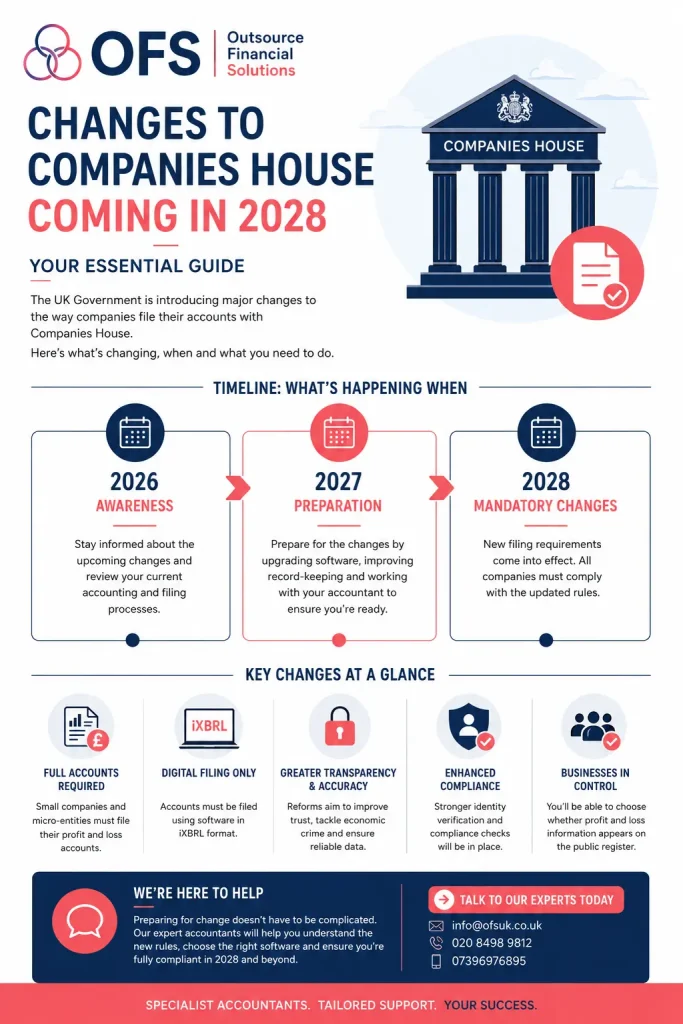
OFS infographic explaining the Companies House changes coming in 2028, including the implementation timeline, key filing requirements, digital accounts changes and contact details for expert accounting support.

Key Changes at a Glance

ChangeWhat It Means for Your Business
Profit and loss accountsSmall and micro-entity companies will be required to file a profit and loss account with Companies House.
Software-only filingPaper submissions and the Companies House web filing service will be phased out, with accounts submitted digitally using approved software.
iXBRL accountsAll accounts must be filed in iXBRL (Inline eXtensible Business Reporting Language), making financial information easier to analyse.
Direct filing from accounting softwareBusinesses will need compatible accounting software that can submit accounts directly to Companies House.
Greater identity verificationCompany directors and those filing on behalf of businesses will face enhanced identity verification requirements.
Improved transparencyThe reforms are designed to improve the accuracy of the Companies House register and reduce fraud across UK businesses.

Who Will Be Affected by the 2028 Companies House Changes?

The new filing requirements will affect the vast majority of UK limited companies that file annual accounts with Companies House. Whether you’re a small business, micro-entity or larger company, it’s important to understand how the changes could affect your reporting obligations.

If you currently rely on paper filing or prepare your accounts manually, you’ll need to move to software that supports digital filing in the required iXBRL format. Businesses already using cloud accounting software such as Xero are likely to find the transition much easier.

If you’re unsure which rules apply to your business, speaking to an accountant well before 2028 can help ensure you’re fully prepared.

Need Help Preparing for the 2028 Changes?

Don’t leave your compliance until the last minute. Our experienced accountants can review your current processes, recommend the right accounting software and ensure your business is fully prepared for the upcoming Companies House reforms

Speak to Our Team Today

Why Are These Changes Being Introduced?

The reforms form part of the Economic Crime and Corporate Transparency Act, which aims to improve the accuracy and reliability of information held at Companies House.

The objectives include:

  • Improving trust in the Companies House register
  • Reducing fraud and economic crime
  • Making company information more reliable for lenders, suppliers and investors
  • Modernising the UK’s company filing system
  • Increasing transparency while giving businesses greater control over commercially sensitive information

Although the new requirements may seem like extra administration, they are designed to create a more secure and trustworthy business environment.

Will small companies need to file profit and loss accounts?

Yes, you will. Small companies, along with micro-entities, will be required to file their profit and loss accounts with Companies House. However, you will have the choice to opt out of that information appearing on the public register. This is in response to concerns from the business and investment community around the privacy and commercial risks that come with sharing this information.

Do I need accounting software to file accounts with Companies House?

Yes, you will need to use accounting software to file your accounts with Companies House. Registered companies will need to file accounts in Inline eXtensible Business Reporting Language (iXBRL) format by using commercial software. The Government does have a list of software providers on GOV.UK to help companies find a suitable software package, so we recommend looking at those to see which one best suits your needs.


Here at Outsource Financial Solutions, we use Xero accounting software. Fully compliant with all current regulations, along with the upcoming changes, it’s seen us achieve great success with our clients and their accounting needs.

Ready for the Companies House changes?

The new filing requirements will affect how your business prepares and submits its accounts. Our experienced accountants can help you stay compliant, choose the right software and prepare well before the changes come into force.

Speak to an Expert →

How Can Businesses Prepare Before 2028?

While the changes don’t come into force until 2028, there are several practical steps you can take now.

Review Your Accounting Software

If you’re still using spreadsheets or desktop software, now is a good time to move to cloud accounting software that supports digital filing.

Keep Better Financial Records

Accurate bookkeeping throughout the year makes preparing annual accounts significantly easier and reduces the risk of errors.

Speak to Your Accountant Early

Rather than waiting until your next year-end, discuss the upcoming changes with your accountant. They’ll be able to review your current processes and recommend any improvements before the new rules become mandatory.

Train Staff

If members of your team are responsible for bookkeeping or submitting information, make sure they understand the new filing requirements.

How can an accountant help me prepare for the 2028 Companies House reforms?

Having an accountant that you can trust makes any regulatory changes so much easier to deal with. We will begin by looking at your current operations and filing methods and seeing if anything you do needs to change when the new rules come in. Then we can ensure that your accounts are filed correctly using the right software, and that your wishes regarding any of this being made public are followed at all times.

How OFS Can Help

Regulatory changes can feel overwhelming, especially if you’re already focused on running your business.

At Outsource Financial Solutions, we help businesses stay compliant while making accounting simpler. We’ll review your current accounting systems, ensure you’re ready for the Companies House reforms and manage your accounts using fully compliant cloud accounting software.

Whether you’re changing software, preparing your first digital filing or simply want reassurance that everything is being done correctly, our experienced team is here to help.

Talk to Us

The Companies House changes coming in 2028 don’t have to be complicated.To find out more about the Companies House accounts filing changes for 2028 and how we can help you, get in touch today! We can’t wait to hear from you and help however we can.

Call Us 0208 498 9812 Get in Touch

Frequently Asked Questions

Will Companies House changes affect sole traders?

No. These reforms apply to companies registered with Companies House. Sole traders are not required to file annual accounts with Companies House, although they still have tax obligations with HMRC.

Will I need to change my accounting software?

Not necessarily. If your current software supports digital filing in iXBRL format and meets Companies House requirements, you may be able to continue using it. If not, you’ll need to switch before the changes take effect.

What is iXBRL?

Inline eXtensible Business Reporting Language (iXBRL) is a digital format used for filing financial information electronically. It allows Companies House and HMRC to process accounts more accurately and efficiently.

When do the new Companies House rules start?

The Government has confirmed that these changes are expected to come into effect during 2028, giving businesses additional time to prepare.

Can my accountant file my accounts for me?

Yes. Most accountants can prepare and submit your annual accounts on your behalf using compliant software, ensuring you meet all filing requirements and deadlines.

Get in Touch With Our Team

Fill out the form below to request a call back from one of our specialists.

The Ultimate Guide to Construction Accounting

What You Will Learn From This Guide

  • Construction accounting is fundamentally different to standard business accounting, with its own rules, compliance requirements and financial tools.
  • CIS (Construction Industry Scheme) governs how contractors pay subcontractors. Getting it wrong attracts HMRC penalties.
  • Job costing and WIP accounting are essential for understanding project-level profitability in real time, not just at year-end.
  • Payroll in construction is more complex than most sectors, with mixed workforces, CIS deductions and employment status risks.

The right accounting software can transform how well you manage cash flow, compliance and project visibility.

Why Construction Accounting Needs Its Own Rulebook

Most businesses can get by with standard accounting software and a generalist accountant. Construction businesses cannot.

The sector has its own tax scheme, its own revenue recognition rules, its own payroll complexity, and its own cash flow pressures. A single project can span multiple financial years, involve dozens of subcontractors with different CIS statuses, generate retention amounts that sit on the books for months, and require stage-payment invoicing that bears no simple relationship to when work was actually done.

Understanding how construction accounting works, and why it differs so significantly from accounting in other industries, is one of the most important things a construction business owner or director can do. It is not just about compliance; it is about having the financial visibility to run projects profitably and make confident decisions.

What is Construction Accounting?

Construction accounting is a specialised branch of financial management built around the way construction projects actually work. Rather than treating the business as a single entity with a single pool of income and expenditure, construction accounting tracks finances at the level of individual contracts and projects.

This is necessary because construction revenue and costs rarely align with standard accounting periods. A building project tendered in January may not begin until April, run through to the following March, and generate retention income that is not received until the year after that. Standard accounting methods would badly misrepresent the financial position at any given point.

What Makes Construction Accounting Different?

FeatureWhy It Matters in Construction
Project-based accountingRevenue and costs must be tracked at job level, not just business-wide
CIS complianceContractors must deduct and report tax on subcontractor payments
RetentionsA percentage of contract value is withheld until the defects period expires
WIP accountingRevenue must be recognised in line with project progress, not invoicing
Mixed workforcePAYE employees, CIS subcontractors and agency workers need different treatment
Stage paymentsIncome arrives in tranches that must be matched to cost and progress
Read More on How Construction Accounting Differs

CIS Explained: The Construction Industry Scheme

The Construction Industry Scheme (CIS) is a tax mechanism specific to the UK construction industry. Under CIS, contractors must deduct money from payments made to subcontractors and pass it directly to HMRC. These deductions are treated as advance payments towards the subcontractor’s Income Tax and National Insurance liability.

It sounds straightforward, but the detail is where most businesses run into difficulty.

CIS Deduction Rates at a Glance

Subcontractor StatusDeduction Rate
Registered with HMRC and verified20%
Not registered or not verifiable30%
Gross payment status approved by HMRC0% (no deduction)

Applying the wrong deduction rate is one of the most common CIS mistakes contractors make, often because a subcontractor has not been verified before work begins, or because their registration status has changed since they were last used. The financial consequences can be significant. HMRC does not treat incorrect deductions as an administrative error; they treat it as a contractor liability, meaning you are responsible for making up any shortfall, plus interest.

If you are unsure whether your deductions have been applied correctly, or you have received a query from HMRC about your CIS returns, it is important to act quickly.

What Happens if CIS Deductions Are Wrong →

⚠️ Verification Is Not Optional

Contractors must verify every new subcontractor with HMRC before making the first payment. Applying the wrong rate, or failing to verify, means the contractor can be held liable for any shortfall, not the subcontractor.

Not confident your CIS is being handled correctly?

CIS errors attract HMRC penalties and can create cash flow problems for your subcontractors. Speak to our CIS specialists today.

Get a CIS Review →

Who Does CIS Apply To?

CIS applies to most construction work carried out in the UK, covering a wide range of activities including groundworks, structural work, interior fit-out, roofing, plumbing, electrical and decorating. Many businesses operate as both a contractor (engaging subcontractors) and a subcontractor (working for a main contractor), meaning they have responsibilities on both sides of the scheme.

To learn more in depth about CIS, read our other articles

ArticleRead More
What is the Construction Industry Scheme? Read article →
How to Register for CIS Read article →
How Does CIS Work for Contractors and Subcontractors? Read article →
Can You Pay a Subcontractor Without CIS? Read article →

Job Costing: Knowing Exactly Where Every Pound Goes

Job costing is the process of recording and allocating every cost, labour, materials, plant hire, subcontractor payments and overheads, against a specific project. It gives you a granular, project-level view of profitability that simply cannot be achieved by looking at business finances as a whole.

In an industry where net profit margins typically sit between 2% and 5%, job costing is not a nice-to-have. It is the mechanism by which profitable construction businesses stay profitable.

What Should Job Costing Track?

Beyond protecting individual project margins, accurate job costing generates a library of real historical data that makes future tenders more accurate, reduces the risk of underpricing or overpricing, and gives you evidence for commercial conversations with clients about variations and additional costs.

Read More On Job Costing

WIP Accounting: Measuring Progress, Not Just Invoices

Work in Progress (WIP) accounting measures how far through a project you actually are and compares that against how much of the budget has been spent. It is the financial mechanism that allows construction businesses to report accurately on long-duration projects across multiple accounting periods.

Without WIP accounting, your reported financial position can be badly distorted. Heavy invoicing in one period can make the business look highly profitable when costs are yet to land. WIP adjusts for this, giving a true picture of where each project stands financially at any point in time.

WIP Percentage Completion: Example

WIP accounting is also critical for businesses that report to shareholders, lenders or investors. Lenders in particular will scrutinise WIP positions when assessing development finance applications or reviewing covenant compliance, making accurate WIP reporting a commercial necessity as well as an accounting one.

Project ValueCosts to Date% CompleteWIP Position
£600,000£180,00032%Under-spent – on track
£600,000£380,00055%Over-spent -investigate
£600,000£560,00088%Near budget – monitor closely

Payroll in Construction: More Complex Than It Looks

Construction payroll is rarely a straightforward exercise. Most construction businesses run a mixed workforce of directly employed PAYE staff, CIS-registered subcontractors and agency workers, often on the same site at the same time. Each category requires different treatment.

⚠️ Employment Status Risk

HMRC actively targets employment status in construction. Treating an employee as self-employed, even if they want to be treated that way, can result in the business being liable for backdated PAYE, National Insurance, interest and penalties stretching back years.

Find Our How Payroll Works in Construction

Is your construction payroll fully compliant?

From CIS deductions to employment status reviews, our team handles the complexity so you do not have to.

Speak to Our Team →

Cash Flow Management in Construction

Poor cash flow is one of the most common causes of construction business failure, and the sector has several structural features that make it particularly challenging:

  • Payment terms of 30 to 90 days are standard throughout the supply chain, meaning costs are often paid well before income is received
  • Retentions of typically 3% to 5% of contract value are withheld by the client for months or years after practical completion
  • Materials and labour must often be funded upfront, before any progress claim is submitted or approved
  • Late payment by main contractors remains a persistent issue in UK construction despite legislative protections

💡 Cash Flow in Practice

A profitable business can still run out of cash. A contractor billing £200,000 per month on 60-day terms is carrying £400,000 of unpaid invoices at any given time. Add retentions and you can see how a thriving business faces a cash crisis without a forecast.

The solution is forecasting. Understanding the expected cash profile of every active project, when costs land, when applications are submitted, when payment is expected, allows you to identify gaps weeks or months in advance and take action before they become a problem.

The Prompt Payment Code, administered by the Small Business Commissioner, sets out the standards large businesses should meet when paying their supply chain. Knowing your rights here is important if you are regularly experiencing late payment from main contractors.

Learn More on How to Maintain a Good Cashflow

Construction Accounting Software: What to Look For

Generic accounting software was not built with construction in mind. While platforms like standard QuickBooks or basic Xero can handle invoicing and bank reconciliation, they typically lack the tools construction businesses need most: job costing, CIS handling, WIP reporting, and retention tracking.

FeatureGeneric SoftwareConstruction-Specific Software
Job costingManual workarounds or missingBuilt-in, project-level by default
CIS deductionsAdd-on requiredNative CIS verification and returns
WIP reportingNot availablePercentage completion built in
Retention trackingManual tracking onlyAutomated retention schedules
Subcontractor managementBasic supplier recordsCommitment schedules and valuations
Progress claimsStandard invoicing onlyApplication for payment workflows

Platforms commonly used in UK construction include Xero with construction add-ons such as Tradify or BigChange, Sage 200 Construction, COINS, and Procore for larger businesses. The right choice depends on your business size, number of active projects, and whether you need integration with project management or site management tools.

We advise on software selection and can support setup and integration as part of our service, making sure the system is configured to give you the job costing and reporting visibility your business needs.

Ready to Get Your Construction Finances Under Control?

Whether you need help with CIS compliance, job costing, payroll or cash flow, our specialist construction accountants are ready to help.

Frequently Asked Questions About Construction Accounting

Construction accounting tracks finances at the level of individual projects rather than the business as a whole. It involves specialist areas including CIS compliance, job costing, WIP revenue recognition, retention accounting and complex payroll structures that do not exist in most other industries.
CIS applies to most businesses carrying out construction work in the UK, including groundworks, structural work, fit-out, roofing, plumbing and electrical. If you engage subcontractors to carry out any of this work, you almost certainly have CIS obligations as a contractor, regardless of your business size.
If you apply the wrong deduction rate or fail to verify a subcontractor, HMRC can hold you liable for the shortfall, plus interest and penalties. In serious cases this can amount to thousands of pounds and is difficult to challenge retrospectively.
Ideally weekly on active projects, with a formal monthly review comparing actual costs against the project estimate. The earlier a cost overrun is identified, the more options you have to address it before it affects the overall project margin.
Retention is a percentage of each payment, typically between 3% and 5%, withheld by the client until a specified period after practical completion. It acts as security against defects. Retentions must be tracked carefully as they represent real income that can take months or years to recover.
Generic accounting software can handle basic bookkeeping but typically lacks job costing, CIS, WIP reporting and retention tracking. Construction-specific software, or a well-configured platform with suitable add-ons, gives you the project-level visibility that makes a real difference to how well you can manage and grow your business.