Construction accounting is much more than recording your income and expenses. With multiple projects, subcontractors, materials, payment schedules and deadlines to keep track of, there are a whole host of moving parts. Costs can also build up well before a customer pays, which is why it’s so important to keep accurate financial records.
For construction companies, good accounting can provide a much clearer picture of where money is being spent, how individual projects are performing and where potential problems may be developing.
Managing Cash Flow
Cash flow can be a challenge even if your business is profitable. Staged payments, delayed invoices, retentions and large upfront costs for labour, materials and equipment can all put pressure on available funds. Regular cash flow forecasts can help businesses anticipate tighter periods, and effective credit control can encourage customers to pay on time.
Tracking Job Costs and Profitability
Knowing whether a project is actually making money is vital. Labour, materials, subcontractors, plant hire, and other expenses need to be allocated accurately to the relevant job.
Without reliable job costing it’s really difficult to see where margins are being squeezed or which projects are performing well.
Staying Compliant With CIS
The Construction Industry Scheme (CIS) brings additional responsibilities when working with subcontractors. Contractors need to verify subcontractors, calculate the correct deductions and submit the required information to HMRC. Keeping accurate records can reduce the risk of errors, incorrect payments and potential penalties.
Managing Subcontractors and Payroll
Many construction businesses deal with both employees and CIS subcontractors, each with different payment and reporting requirements. Keeping these records organised helps ensure payroll deductions and project costs are dealt with correctly.
Getting VAT Right
VAT can become complicated depending on the type of work being carried out and who the customer is. The Domestic Reverse Charge for Construction may also apply to certain transactions, meaning the customer accounts for the VAT rather than the supplier.
Tracking Retentions
Retentions are amounts that are held back from payments until certain contractual requirements have been met. If they are not recorded properly, a business may have an inaccurate picture of the income it is expecting.
Maintaining clear records makes it much easier to keep track of what is owed and when retained amounts may become payable.
Challenge
Why It Causes Problems
How Good Accounting Helps
Cash flow
Payments may be delayed
Forecast any future cash needs
Job costing
Project margins can be unclear
Track income and costs
CIS
Incorrect deductions create compliance risks
Maintain accurate records
VAT
Rules may vary between transactions
Supports correct reporting
Retentions
Income may be delayed
Tracks amounts due
Keeping Accurate Records
Late or incomplete bookkeeping can leave business owners relying on outdated figures. Recording invoices, expenses, payroll and project costs regularly makes it much easier to understand current performance and spot potential problems early.
Planning Ahead
Accounts explain what has already happened, but construction businesses also need to look at what is coming next. Budgets, forecasts and management accounts can help with planning upcoming projects, staffing, costs, and cash requirements.
A Useful Accounting Tip:
Regular financial reviews can highlight issues before they become expensive. Looking at project margins, outstanding invoices, cash flow and upcoming commitments gives business owners a clearer picture of your company’s financial position.
Final Thoughts
Construction accounting involves much more than keeping the books up to date. From cash flow and job costing to CIS, VAT and retention, accurate financial information can help businesses protect their margins and make better-informed decisions.
Working with accountants who understand the construction industry can also take some of the pressure off, helping your business to maintain accurate records whilst keeping sight of the bigger picture.
Construction businesses have a lot to keep track of financially. Projects can run for months, costs can change as work progresses and several jobs may be underway at the same time. Add subcontractors, materials, labour, retentions and staged payments to the mix, and accurate bookkeeping becomes an essential part of running your business.
Good construction bookkeeping is about much more than completing the accounts at the end of the year. Keeping financial records up to date throughout the year gives you as a business owner a clearer picture of how individual projects are performing and where profits might be at risk.
Why Does Accurate Bookkeeping Matter?
For construction companies, financial information needs to show what is happening across each project. Recording income and expenditure against the correct job can highlight which projects are profitable and which may be costing more than expected.
Accurate records also make it easier to monitor labour, materials, and subcontractor payments as work progresses. This can help identify rising costs before they have a significant effect on the final margin.
Good bookkeeping can support accurate CIS reporting, help businesses monitor outstanding invoices and provide a clearer picture of available cash. It can also provide useful information when pricing future work or deciding whether to take on a new contract.
What Happens When Construction Bookkeeping Is Inaccurate?
Even relatively small errors can affect profitability over time. If costs are missed or recorded against the wrong project, a job may appear more profitable than it actually is. Unpaid invoices may also be overlooked, putting additional pressure on cash flow.
Poor records can result in incomplete management information, unexpected tax liabilities and business decisions being made without a full picture of your company’s finances.
Good Bookkeeping
Poor Bookkeeping
Project costs are recorded accurately
Costs may be missed or allocated incorrectly
Profit margins can be monitored
Project profitability may be unclear
Outstanding invoices are visible
Cash flow issues can go unnoticed
Records support tax and CIS compliance
Errors can create additional liabilities
Current management accounts are available
Decisions may rely on outdated information
Using Bookkeeping to Support Better Decisions
Reliable financial information can be useful for your business, and goes above and beyond everyday accounting. Construction businesses can use accurate records to prepare management accounts, assess gross and net profit and make informed pricing and tendering decisions.
For businesses managing several contracts, construction industry accounting can also provide a clearer picture of overall performance, rather than relying solely on your year-end figures.
Top Tip!
Don’t wait until year end to discover that a project has become less profitable than expected. Regular bookkeeping and management reviews can highlight rising costs, falling margins, and outstanding payments while there is still time to respond.
Protecting Your Construction Profits
Accurate construction bookkeeping gives you as the business owner the information you need to monitor projects, manage cash flow, and protect your margins. It can also support tax and compliance requirements while providing a stronger basis for financial decisions.
If your business would benefit from specialist support, speak to OFS about construction bookkeeping services and specialist accounting for construction companies.
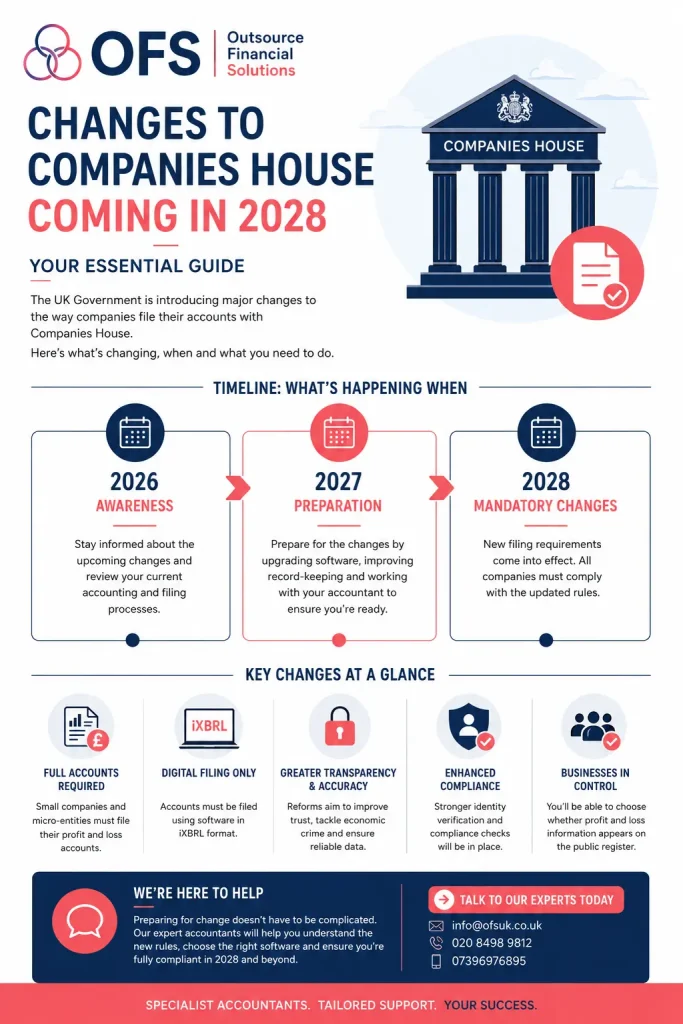
There has been big news in the business accounting world. The Government is bringing in Companies House compliance changes that will affect a number of businesses. What are they, and what will you have to do? Don’t worry, we’re on hand to answer all of your questions so that you can remain compliant with all rules and regulations. As the accountants so many businesses rely on, we’re here to talk you through all of the Companies House changes 2028 has in store. Ready? Let’s get into it!
What changes are coming to Companies House in 2028?
The UK Government has just announced changes to what information businesses must report when filing their annual accounts with Companies House, and how they need to do it. These reforms were brought in to ensure that the data on the companies register is accurate, reliable and presented with the highest level of transparency. It will also help to inform business decisions, ensure our practices are modernised and in line with other countries, and also help to tackle economic crime.
The Government did originally plan to introduce these Companies House accounts filing changes in 2027, but they were pushed to 2028 in order to give businesses more time to prepare. So you now have a full tax year and just over eight months to prepare. This is great news for any business with concerns about how they are going to deal with the changes, but it also gives you no excuse not to be ready when the time comes!
Let’s find out a bit more about what those changes are and what you need to do.
Key Changes at a Glance
Change
What It Means for Your Business
Profit and loss accounts
Small and micro-entity companies will be required to file a profit and loss account with Companies House.
Software-only filing
Paper submissions and the Companies House web filing service will be phased out, with accounts submitted digitally using approved software.
iXBRL accounts
All accounts must be filed in iXBRL (Inline eXtensible Business Reporting Language), making financial information easier to analyse.
Direct filing from accounting software
Businesses will need compatible accounting software that can submit accounts directly to Companies House.
Greater identity verification
Company directors and those filing on behalf of businesses will face enhanced identity verification requirements.
Improved transparency
The reforms are designed to improve the accuracy of the Companies House register and reduce fraud across UK businesses.
Who Will Be Affected by the 2028 Companies House Changes?
The new filing requirements will affect the vast majority of UK limited companies that file annual accounts with Companies House. Whether you’re a small business, micro-entity or larger company, it’s important to understand how the changes could affect your reporting obligations.
If you currently rely on paper filing or prepare your accounts manually, you’ll need to move to software that supports digital filing in the required iXBRL format. Businesses already using cloud accounting software such as Xero are likely to find the transition much easier.
If you’re unsure which rules apply to your business, speaking to an accountant well before 2028 can help ensure you’re fully prepared.
Need Help Preparing for the 2028 Changes?
Don’t leave your compliance until the last minute. Our experienced accountants can review your current processes, recommend the right accounting software and ensure your business is fully prepared for the upcoming Companies House reforms
The reforms form part of the Economic Crime and Corporate Transparency Act, which aims to improve the accuracy and reliability of information held at Companies House.
The objectives include:
Improving trust in the Companies House register
Reducing fraud and economic crime
Making company information more reliable for lenders, suppliers and investors
Modernising the UK’s company filing system
Increasing transparency while giving businesses greater control over commercially sensitive information
Although the new requirements may seem like extra administration, they are designed to create a more secure and trustworthy business environment.
Will small companies need to file profit and loss accounts?
Yes, you will. Small companies, along with micro-entities, will be required to file their profit and loss accounts with Companies House. However, you will have the choice to opt out of that information appearing on the public register. This is in response to concerns from the business and investment community around the privacy and commercial risks that come with sharing this information.
Do I need accounting software to file accounts with Companies House?
Yes, you will need to use accounting software to file your accounts with Companies House. Registered companies will need to file accounts in Inline eXtensible Business Reporting Language (iXBRL) format by using commercial software. The Government does have a list of software providers on GOV.UK to help companies find a suitable software package, so we recommend looking at those to see which one best suits your needs.
Here at Outsource Financial Solutions, we use Xero accounting software. Fully compliant with all current regulations, along with the upcoming changes, it’s seen us achieve great success with our clients and their accounting needs.
Ready for the Companies House changes?
The new filing requirements will affect how your business prepares and submits its accounts. Our experienced accountants can help you stay compliant, choose the right software and prepare well before the changes come into force.
While the changes don’t come into force until 2028, there are several practical steps you can take now.
Review Your Accounting Software
If you’re still using spreadsheets or desktop software, now is a good time to move to cloud accounting software that supports digital filing.
Keep Better Financial Records
Accurate bookkeeping throughout the year makes preparing annual accounts significantly easier and reduces the risk of errors.
Speak to Your Accountant Early
Rather than waiting until your next year-end, discuss the upcoming changes with your accountant. They’ll be able to review your current processes and recommend any improvements before the new rules become mandatory.
Train Staff
If members of your team are responsible for bookkeeping or submitting information, make sure they understand the new filing requirements.
How can an accountant help me prepare for the 2028 Companies House reforms?
Having an accountant that you can trust makes any regulatory changes so much easier to deal with. We will begin by looking at your current operations and filing methods and seeing if anything you do needs to change when the new rules come in. Then we can ensure that your accounts are filed correctly using the right software, and that your wishes regarding any of this being made public are followed at all times.
How OFS Can Help
Regulatory changes can feel overwhelming, especially if you’re already focused on running your business.
At Outsource Financial Solutions, we help businesses stay compliant while making accounting simpler. We’ll review your current accounting systems, ensure you’re ready for the Companies House reforms and manage your accounts using fully compliant cloud accounting software.
Whether you’re changing software, preparing your first digital filing or simply want reassurance that everything is being done correctly, our experienced team is here to help.
Talk to Us
The Companies House changes coming in 2028 don’t have to be complicated.To find out more about the Companies House accounts filing changes for 2028 and how we can help you, get in touch today! We can’t wait to hear from you and help however we can.
No. These reforms apply to companies registered with Companies House. Sole traders are not required to file annual accounts with Companies House, although they still have tax obligations with HMRC.
Will I need to change my accounting software?
Not necessarily. If your current software supports digital filing in iXBRL format and meets Companies House requirements, you may be able to continue using it. If not, you’ll need to switch before the changes take effect.
What is iXBRL?
Inline eXtensible Business Reporting Language (iXBRL) is a digital format used for filing financial information electronically. It allows Companies House and HMRC to process accounts more accurately and efficiently.
When do the new Companies House rules start?
The Government has confirmed that these changes are expected to come into effect during 2028, giving businesses additional time to prepare.
Can my accountant file my accounts for me?
Yes. Most accountants can prepare and submit your annual accounts on your behalf using compliant software, ensuring you meet all filing requirements and deadlines.
Get in Touch With Our Team
Fill out the form below to request a call back from one of our specialists.
Construction accounting is fundamentally different to standard business accounting, with its own rules, compliance requirements and financial tools.
CIS (Construction Industry Scheme) governs how contractors pay subcontractors. Getting it wrong attracts HMRC penalties.
Job costing and WIP accounting are essential for understanding project-level profitability in real time, not just at year-end.
Payroll in construction is more complex than most sectors, with mixed workforces, CIS deductions and employment status risks.
The right accounting software can transform how well you manage cash flow, compliance and project visibility.
Why Construction Accounting Needs Its Own Rulebook
Most businesses can get by with standard accounting software and a generalist accountant. Construction businesses cannot.
The sector has its own tax scheme, its own revenue recognition rules, its own payroll complexity, and its own cash flow pressures. A single project can span multiple financial years, involve dozens of subcontractors with different CIS statuses, generate retention amounts that sit on the books for months, and require stage-payment invoicing that bears no simple relationship to when work was actually done.
Understanding how construction accounting works, and why it differs so significantly from accounting in other industries, is one of the most important things a construction business owner or director can do. It is not just about compliance; it is about having the financial visibility to run projects profitably and make confident decisions.
What is Construction Accounting?
Construction accounting is a specialised branch of financial management built around the way construction projects actually work. Rather than treating the business as a single entity with a single pool of income and expenditure, construction accounting tracks finances at the level of individual contracts and projects.
This is necessary because construction revenue and costs rarely align with standard accounting periods. A building project tendered in January may not begin until April, run through to the following March, and generate retention income that is not received until the year after that. Standard accounting methods would badly misrepresent the financial position at any given point.
What Makes Construction Accounting Different?
Feature
Why It Matters in Construction
Project-based accounting
Revenue and costs must be tracked at job level, not just business-wide
CIS compliance
Contractors must deduct and report tax on subcontractor payments
Retentions
A percentage of contract value is withheld until the defects period expires
WIP accounting
Revenue must be recognised in line with project progress, not invoicing
Mixed workforce
PAYE employees, CIS subcontractors and agency workers need different treatment
Stage payments
Income arrives in tranches that must be matched to cost and progress
The Construction Industry Scheme (CIS) is a tax mechanism specific to the UK construction industry. Under CIS, contractors must deduct money from payments made to subcontractors and pass it directly to HMRC. These deductions are treated as advance payments towards the subcontractor’s Income Tax and National Insurance liability.
It sounds straightforward, but the detail is where most businesses run into difficulty.
CIS Deduction Rates at a Glance
Subcontractor Status
Deduction Rate
Registered with HMRC and verified
20%
Not registered or not verifiable
30%
Gross payment status approved by HMRC
0% (no deduction)
Applying the wrong deduction rate is one of the most common CIS mistakes contractors make, often because a subcontractor has not been verified before work begins, or because their registration status has changed since they were last used. The financial consequences can be significant. HMRC does not treat incorrect deductions as an administrative error; they treat it as a contractor liability, meaning you are responsible for making up any shortfall, plus interest.
If you are unsure whether your deductions have been applied correctly, or you have received a query from HMRC about your CIS returns, it is important to act quickly.
Contractors must verify every new subcontractor with HMRC before making the first payment. Applying the wrong rate, or failing to verify, means the contractor can be held liable for any shortfall, not the subcontractor.
Not confident your CIS is being handled correctly?
CIS errors attract HMRC penalties and can create cash flow problems for your subcontractors. Speak to our CIS specialists today.
CIS applies to most construction work carried out in the UK, covering a wide range of activities including groundworks, structural work, interior fit-out, roofing, plumbing, electrical and decorating. Many businesses operate as both a contractor (engaging subcontractors) and a subcontractor (working for a main contractor), meaning they have responsibilities on both sides of the scheme.
To learn more in depth about CIS, read our other articles
Job Costing: Knowing Exactly Where Every Pound Goes
Job costing is the process of recording and allocating every cost, labour, materials, plant hire, subcontractor payments and overheads, against a specific project. It gives you a granular, project-level view of profitability that simply cannot be achieved by looking at business finances as a whole.
In an industry where net profit margins typically sit between 2% and 5%, job costing is not a nice-to-have. It is the mechanism by which profitable construction businesses stay profitable.
What Should Job Costing Track?
Beyond protecting individual project margins, accurate job costing generates a library of real historical data that makes future tenders more accurate, reduces the risk of underpricing or overpricing, and gives you evidence for commercial conversations with clients about variations and additional costs.
WIP Accounting: Measuring Progress, Not Just Invoices
Work in Progress (WIP) accounting measures how far through a project you actually are and compares that against how much of the budget has been spent. It is the financial mechanism that allows construction businesses to report accurately on long-duration projects across multiple accounting periods.
Without WIP accounting, your reported financial position can be badly distorted. Heavy invoicing in one period can make the business look highly profitable when costs are yet to land. WIP adjusts for this, giving a true picture of where each project stands financially at any point in time.
WIP Percentage Completion: Example
WIP accounting is also critical for businesses that report to shareholders, lenders or investors. Lenders in particular will scrutinise WIP positions when assessing development finance applications or reviewing covenant compliance, making accurate WIP reporting a commercial necessity as well as an accounting one.
Project Value
Costs to Date
% Complete
WIP Position
£600,000
£180,000
32%
Under-spent – on track
£600,000
£380,000
55%
Over-spent -investigate
£600,000
£560,000
88%
Near budget – monitor closely
Payroll in Construction: More Complex Than It Looks
Construction payroll is rarely a straightforward exercise. Most construction businesses run a mixed workforce of directly employed PAYE staff, CIS-registered subcontractors and agency workers, often on the same site at the same time. Each category requires different treatment.
⚠️ Employment Status Risk
HMRC actively targets employment status in construction. Treating an employee as self-employed, even if they want to be treated that way, can result in the business being liable for backdated PAYE, National Insurance, interest and penalties stretching back years.
Poor cash flow is one of the most common causes of construction business failure, and the sector has several structural features that make it particularly challenging:
Payment terms of 30 to 90 days are standard throughout the supply chain, meaning costs are often paid well before income is received
Retentions of typically 3% to 5% of contract value are withheld by the client for months or years after practical completion
Materials and labour must often be funded upfront, before any progress claim is submitted or approved
Late payment by main contractors remains a persistent issue in UK construction despite legislative protections
💡 Cash Flow in Practice
A profitable business can still run out of cash. A contractor billing £200,000 per month on 60-day terms is carrying £400,000 of unpaid invoices at any given time. Add retentions and you can see how a thriving business faces a cash crisis without a forecast.
The solution is forecasting. Understanding the expected cash profile of every active project, when costs land, when applications are submitted, when payment is expected, allows you to identify gaps weeks or months in advance and take action before they become a problem.
The Prompt Payment Code, administered by the Small Business Commissioner, sets out the standards large businesses should meet when paying their supply chain. Knowing your rights here is important if you are regularly experiencing late payment from main contractors.
Construction Accounting Software: What to Look For
Generic accounting software was not built with construction in mind. While platforms like standard QuickBooks or basic Xero can handle invoicing and bank reconciliation, they typically lack the tools construction businesses need most: job costing, CIS handling, WIP reporting, and retention tracking.
Feature
Generic Software
Construction-Specific Software
Job costing
Manual workarounds or missing
Built-in, project-level by default
CIS deductions
Add-on required
Native CIS verification and returns
WIP reporting
Not available
Percentage completion built in
Retention tracking
Manual tracking only
Automated retention schedules
Subcontractor management
Basic supplier records
Commitment schedules and valuations
Progress claims
Standard invoicing only
Application for payment workflows
Platforms commonly used in UK construction include Xero with construction add-ons such as Tradify or BigChange, Sage 200 Construction, COINS, and Procore for larger businesses. The right choice depends on your business size, number of active projects, and whether you need integration with project management or site management tools.
We advise on software selection and can support setup and integration as part of our service, making sure the system is configured to give you the job costing and reporting visibility your business needs.
Ready to Get Your Construction Finances Under Control?
Whether you need help with CIS compliance, job costing, payroll or cash flow, our specialist construction accountants are ready to help.
Frequently Asked Questions About Construction Accounting
Construction accounting tracks finances at the level of individual projects rather than the business as a whole. It involves specialist areas including CIS compliance, job costing, WIP revenue recognition, retention accounting and complex payroll structures that do not exist in most other industries.
CIS applies to most businesses carrying out construction work in the UK, including groundworks, structural work, fit-out, roofing, plumbing and electrical. If you engage subcontractors to carry out any of this work, you almost certainly have CIS obligations as a contractor, regardless of your business size.
If you apply the wrong deduction rate or fail to verify a subcontractor, HMRC can hold you liable for the shortfall, plus interest and penalties. In serious cases this can amount to thousands of pounds and is difficult to challenge retrospectively.
Ideally weekly on active projects, with a formal monthly review comparing actual costs against the project estimate. The earlier a cost overrun is identified, the more options you have to address it before it affects the overall project margin.
Retention is a percentage of each payment, typically between 3% and 5%, withheld by the client until a specified period after practical completion. It acts as security against defects. Retentions must be tracked carefully as they represent real income that can take months or years to recover.
Generic accounting software can handle basic bookkeeping but typically lacks job costing, CIS, WIP reporting and retention tracking. Construction-specific software, or a well-configured platform with suitable add-ons, gives you the project-level visibility that makes a real difference to how well you can manage and grow your business.
Making Tax Digital (MTD) is changing the way many UK businesses and landlords keep financial records and report income to HMRC. For some sole traders and landlords, the changes are no longer something to prepare for in the future. Making Tax Digital for Income Tax became mandatory for those within the first threshold from 6 April 2026, with the first quarterly update deadline on 7 August 2026.
With further businesses coming into the system in 2027 and 2028, understanding what MTD means now can help you avoid a last-minute scramble with your accounting records and software.
⚠️ Important: First Making Tax Digital Deadline
If you’re required to use Making Tax Digital for Income Tax from April 2026, your first quarterly update covering 6 April to 5 July 2026 must be submitted to HMRC by:
7 August 2026
If you haven’t prepared yet, don’t leave it until the last minute. Contact OFS as soon as possible and our team can help you understand whether MTD applies to you, get your records in order and make sure you’re using suitable accounting software.
Making Tax Digital is HMRC’s move towards a more digital tax system. Rather than relying on traditional spreadsheets, paper records and a single Self Assessment submission at the end of the year, businesses within MTD for Income Tax must keep certain records digitally and send HMRC quarterly updates through compatible software.
It is important to understand that a quarterly update is not the same as a tax return. The quarterly submission provides HMRC with a summary of your business income and expenses. You will still need to complete your end-of-year tax return and make any necessary adjustments before submitting it and paying your tax.
The system is designed to give businesses and HMRC more up-to-date information about income and tax liabilities throughout the year.
In simple terms, MTD means:
Keeping relevant business records digitally
Using MTD-compatible accounting software
Sending quarterly income and expense updates to HMRC
Reviewing and correcting your records throughout the year
Completing an end-of-year tax return
Paying your tax by the usual deadline
Who Needs to Use Making Tax Digital for Income Tax?
This is one of the most important questions for business owners.
MTD for Income Tax currently applies to sole traders and landlords who are registered for Self Assessment and whose qualifying income is above the relevant threshold.
The rollout is being introduced in stages:
Tax year used to determine qualifying income
Qualifying income
MTD starts
2024/25
More than £50,000
6 April 2026
2025/26
More than £30,000
6 April 2027
2026/27
More than £20,000
6 April 2028
Qualifying income is based on your total turnover from self-employment and property income before expenses, rather than your profit. This is an important distinction because a business with relatively modest profits could still fall within the MTD requirements if its turnover exceeds the relevant threshold.
HMRC has also confirmed that partnerships will be brought into MTD for Income Tax in the future, although the timetable for partnerships has not yet been set.
Important: If you are a limited company, MTD for Income Tax does not apply to your company’s Corporation Tax simply because you operate a business. The current MTD for Income Tax rollout is focused on individuals with self-employment and property income.
What Is the First Making Tax Digital Deadline?
For those entering MTD for Income Tax from April 2026, the first quarterly update covers the period 6 April to 5 July 2026.
The deadline for submitting it is:
7 August 2026
HMRC has confirmed that more than 864,000 sole traders and landlords are within the initial MTD population.
The standard quarterly timetable is:
Period covered
Quarterly update deadline
6 April to 5 July
7 August
6 April to 5 October
7 November
6 April to 5 January
7 February
6 April to 5 April
7 May
There is also an option to use calendar-based update periods if your accounting period runs from 1 April to 31 March. The submission deadlines remain the same.
What Information Do You Need to Keep Digitally?
You need to maintain digital records of relevant income and expenses for your self-employment and property businesses.
For each transaction, your digital records generally need to include information such as:
The amount
The date
The relevant income or expense category
Details needed to support the transaction
You must also continue to keep supporting records, such as invoices and bank statements. Going digital does not mean you can simply throw away your underlying evidence.
The exact records you need will depend on the type and size of your business.
What About Spreadsheets?
This is an area where business owners need to be careful.
Simply having a spreadsheet on your computer does not automatically mean you have met all MTD requirements. You need to use software that is compatible with MTD for Income Tax.
There can, however, be situations where spreadsheets form part of a compliant digital record-keeping system, provided the necessary digital links and software requirements are met.
For many small businesses, moving to suitable accounting software is likely to be the simplest approach.
What Is MTD-Compatible Software?
You need to use software that works with Making Tax Digital for Income Tax to maintain your digital records and submit quarterly updates.
HMRC does not provide the accounting software itself. Instead, businesses can choose from compatible commercial software and should check that their chosen product supports the specific MTD functions they require.
This is why it is worth checking your software well before your first deadline.
You should consider:
Whether it is MTD-compatible
Whether it connects to your bank
Whether your accountant can access it
How easy it is to record expenses
Whether it produces useful financial reports
Whether it can submit quarterly updates
Whether it will continue to meet your needs as your business grows
Does MTD Replace Self Assessment?
Not completely.
This is one of the biggest misconceptions surrounding Making Tax Digital.
Quarterly updates do not replace the end-of-year tax return. You will still need to review your figures, make relevant adjustments, claim applicable reliefs and allowances, include other income where required and submit your final tax return.
For those starting MTD for Income Tax from April 2026, the first MTD tax return will relate to the 2026/27 tax year and will need to be submitted by 31 January 2028.
This means the introduction of quarterly reporting does not mean you will suddenly have four tax returns to complete each year.
Are There Penalties for Missing MTD Deadlines?
There are penalties for failing to meet certain MTD obligations, but there is an important transitional point for the first year.
HMRC has confirmed that penalty points will not be applied for late quarterly updates during the 2026/27 tax year. However, penalties can still apply to late tax returns and late tax payments.
From later tax years, the points-based system will apply to missed quarterly updates. Generally, reaching four penalty points results in a £200 penalty, with further penalties possible for additional missed deadlines.
This means businesses should not treat the first-year penalty relaxation as a reason to ignore the deadlines. Getting your processes right from the beginning will make future compliance much easier.
What Happens If Your Income Falls Below the Threshold?
Your position is determined using the qualifying income rules for the relevant tax year.
For example, someone who has qualifying income above £50,000 based on their 2024/25 tax return will need to use MTD from April 2026, even if their income subsequently changes.
If you are unsure whether you are within the rules, HMRC provides an online checker to help establish when you need to start using MTD and whether you may qualify for an exemption.
Can You Be Exempt From Making Tax Digital?
Yes, exemptions are available in certain circumstances.
For example, you may be able to apply for an exemption if you are digitally excluded, meaning it is not reasonable or practical for you to use digital tools because of factors such as age, disability or other circumstances.
Exemptions are not automatic in every situation, so if you believe MTD would be impractical for you, check the relevant HMRC guidance rather than simply choosing not to comply.
How Can an Accountant Help With Making Tax Digital?
Making Tax Digital is ultimately about more than buying accounting software.
Your accountant can help you determine whether you are within the MTD rules, calculate your qualifying income, select suitable software and establish processes for recording income and expenses.
They can also help you understand what the figures actually mean.
This is particularly valuable because quarterly reporting gives business owners more frequent insight into their financial position. Instead of waiting until the end of the tax year to discover how profitable the business has been, you can use up-to-date financial information to make better decisions throughout the year.
An accountant can also review your records before quarterly submissions, identify errors and help you prepare for your final tax return.
What Should Businesses Do Now?
The biggest mistake is assuming that MTD is simply an HMRC form that needs to be completed four times a year.
The real change is the move towards continuous digital record keeping and more regular financial reporting.
For businesses already using cloud accounting software and keeping accurate records, the transition may be relatively straightforward. For those relying on spreadsheets, paper records or catching up with bookkeeping once a year, there is likely to be considerably more preparation involved.
Getting organised now can make the transition much easier and may also give you a better understanding of your business finances.
Need Help With Making Tax Digital?
Not sure whether Making Tax Digital applies to you or what you need to do before the deadline? Get in touch with our team for advice and support.